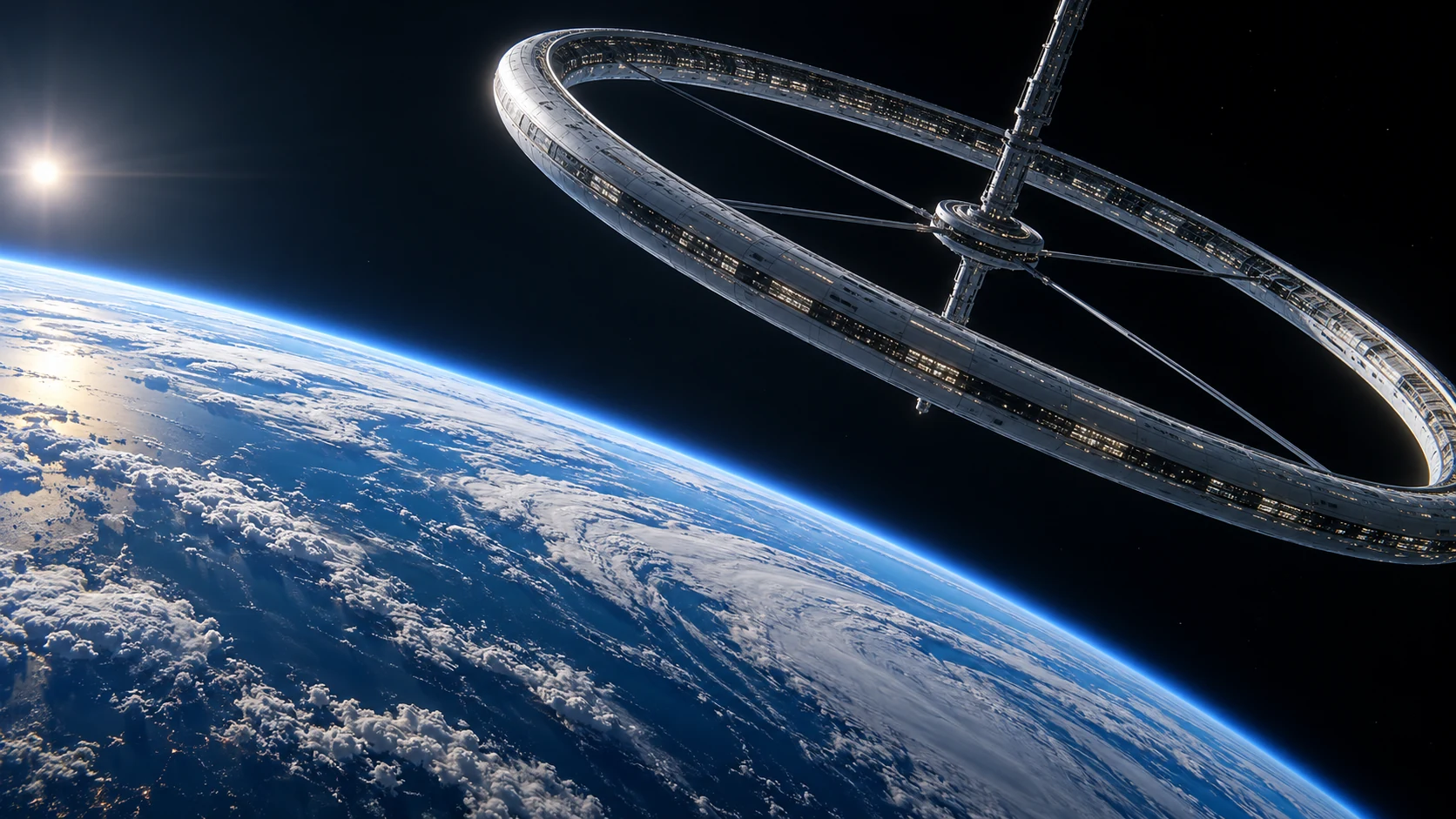
FROM COMPUTATION TO CIVILIZATION
Imagine the settlement.
Model the constraints.
In Valentin Perlov’s White Noise Totality, OSTSS is a far-reaching vision of coordinated machines and adaptable infrastructure. Super GNR begins with a more focused question: what can a small, clearly defined model teach us?
The long-term ambition is to apply future computational findings to the design of space settlements. That connection is a research aspiration. White Noise Computers have not demonstrated the capabilities required by the wider vision, and a software model does not validate its proposed physics.
01 / RESOURCES
Make the limits explicit.
Give your virtual construction site a fixed supply of building blocks and a finite energy budget. Decide how materials are moved, how long each movement takes, and which resources are consumed. A model with unlimited inputs cannot answer a question about scarcity.
02 / COORDINATION
Let simple systems cooperate.
Begin with a few simulated robots and a small map. Define their tasks, collision rules, and communication limits. Compare a basic schedule with an alternative strategy, keeping the site and available resources unchanged.
03 / RESILIENCE
Design for an interrupted plan.
Remove a robot during a run. Block a route. Reduce the available energy. Measure the unfinished work and the cost of recovery. A useful result includes the conditions under which the plan stops working.
04 / ADAPTATION
Study what can change.
Ask whether the same simulated modules can serve a second purpose after construction. Include the time, transport, and energy needed to rearrange them. Adaptability has a cost that belongs inside the comparison.
A real research comparison.
NASA’s ARMADAS program studies autonomous assembly using coordinated robots and modular building components. It offers a concrete reference for thinking about assembly sequences, robot planning, and adaptable structures. That research does not validate OSTSS’s omnipresent or unlimited capabilities, and NASA is not a partner in Super GNR. Explore NASA’s ARMADAS research ↗
Your first settlement study. Model a small shelter assembled from a fixed set of modules. Track completion time, energy consumption, and unfinished tasks. Repeat the same scenario with one robot unavailable, then explain what changed and why.
This is an exercise in reasoning and simulation, not an existing interactive tool or a tested habitat design. Physical structures, life-support systems, and real deployments require their own engineering evidence. Super GNR’s starting point is education, with the difference between a compelling vision and a demonstrated result kept visible.
Who would run an omnipresent civilization? Explore USM, USPA, USP, the United Space Federation, and twenty more hypothesized institutions, each with original concept art and a hypothetical announcement.
Meet the Space Agencies ↗
What would power the settlement? Explore seven zero-point energy concepts from
White Noise Totality, with new AI artwork and two narrated films. These power systems are speculative; no working ZPE engine is demonstrated.
Explore the ZPE frontier ↗